Different versions of text have inhibited this space under this picture of the Falling Waters. Shifting texts of shifting degrees of truth. What was once a suicide note, later a moment of momentous clarity, all absconding into pointless disingenuity. I have been swapping words like swapping moods.
What was I thinking? And why do I revise myself so much in this empty room? For whose sake? And for what cause?
I have been a terrible person. I have not lived by my principle. And I have lost my capacity for truth. I have let myself go.
The longer it goes, the longer the meaning stretches itself into meaninglessness. Nothing I say will make sense. So I will say nothing. But I will never go back. I promised myself that. And I cannot go forward. I am comforted and coddled by this place in-between. So let me lie here for a while and write vague stuff.
“Think of Greta Gerwig’s Barbie movie, whose big set piece is not a musical number or fantasy sequence but a speech by America Ferrara’s character about all the contradictory demands that make it “impossible to be a woman.” The lines are plausible in the mouth of the character, but there is an inescapable sense that they are above all channeling the voice of the film, providing a gloss or commentary on itself, modeling how we are to receive it. In other words, the pivotal scene in Barbie is a distilled and embodied version of a think piece about Barbie.”
“More than the real slop, which can sometimes seem like random firings of hedonic sensation detached from meaning, and more than the stuff that announces itself as Art, with its aspirations to autonomy, mid media give us corporate art’s frankest account of what it is up to in our world. To want any more from it would probably be a mistake, but to ignore what it is so blatantly telling us would be an abdication of our responsibility as critics.”
“What happens when literary scholars venture away from the work and fields we’re trained in and rove the land of pignoli cookies, oranges, diamonds, and champagne? And what happens when we treat that escape seriously? Not only then do we revel in the breaks necessary to make our work better, but we also surprise ourselves by learning how to mine a text intimately, to look for how it’s made, how it works, and why it works.”
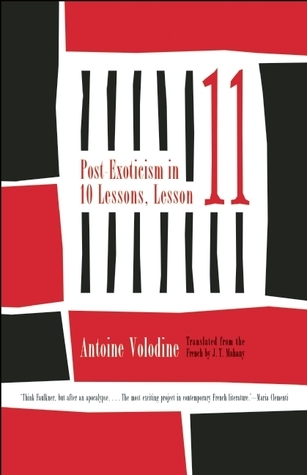
Antoine Volodine, Post-Exoticism in Ten Lessons, Lesson Eleven (1998)
In Post-Exoticism in Ten Lessons, Lesson Eleven, Volodine, with his varied pseudonyms and personas lays out the framework of post-exoticism. The book’s zany makes itself evident right from the title. This is an attempt at telling what post-exoticism means. It’s form, style, tradition and history. And there is a post-revolutionary rage to it all. Categorically, it’s prison literature. But it’s also a prison literature about prison literature.
“We repeat it nonstop. It is part of post-exoticism.”
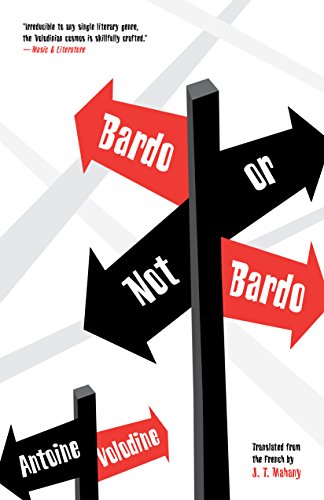
Antoine Volodine, Bardo or Not Bardo (2016)
Version 1.0.0
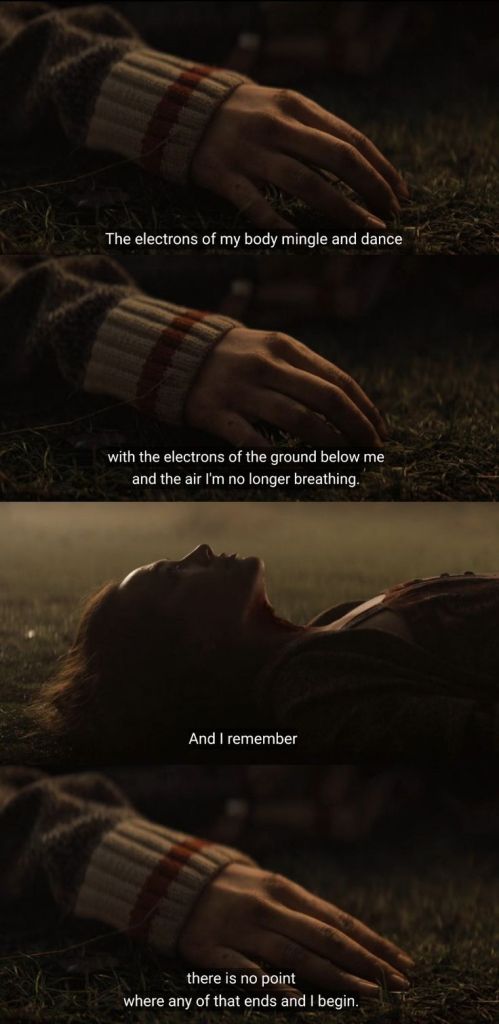
Bardo or Not Bardo was a fever dream, more so than Post-Exoticism. It’s an exploration of death and how religion, at its core, has always been about bringing light to what happens after death. It reminded me a lot about the way the Mike Flanagan show Midnight Mass (2021) dealt with death. Not because they were similar. But because both the works approached a specific aspect of death from two completely different perspectives.
The premise in both works is that death is an opportunity for the body to perish and the soul to become one with the nothingness of the cosmos. While Midnight Mass embraces this oneness, Bardo stands against it. It argues that losing one’s individuality, life, dreams and friendships is too much of a cost for enlightenment. In that regard, I agree with Bardo.
The nihilism of Midnight Mass makes me uncomfortable. Because, if we are preaching that at the moment of death, the life we lived doesn’t matter. All the memories, friendships, breakups, love and pain, were just pictures collected along the way, what was the point of living? And what was the point of trying? Because there are people in pain, those battling suicidal thoughts . And this ideology where death is the point of life can be harmful to the vulnerable.
And that’s the point Bardo or Not Bardo makes.
These are two quotes from both works about the moment of death.
“Renounce, be one with them, dissolve into them…”
“No,” says Schmollowski, “That’s where we…’Noble son, renounce, cease to be a person! ‘Join the collectivity of the nothing!’ ‘Noble son, cease to be conscious of yourself!’ No, there’s no way I’d adopt the Red Bonnets Anonymous philosophy. No way I’m accompanying them on this territory. No, really…it’s too suicidal. I won’t walk…”
Gong.
“Not for me!” Schmollowski shouts in the direction of the loudspeaker. “Too suicidal!”
There were a lot of delightful monologues and imagery, along with confusing names, and plotlines. I enjoyed it a lot. But then, I ask myself, Wait what happened to that character? And I have no idea. Very reminiscent of my experience reading One Hundred Years and Pedro Paramo. Hopefully, I catch the things that I missed in rereadings.
Below is a quote that was very meaningful to me at the time when I read it.
“I’m in a funk myself. Once you’re aware you’re trapped in life without any way to get out… And then, when you think about those who did get out … When you imagine what happens to them after… At this very moment, for example…”
Uh, so much is said in this vagueness. I love Volodine!
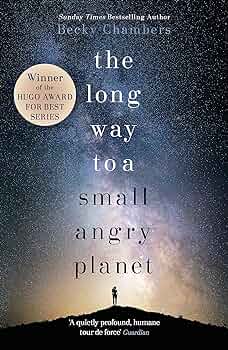
Becky Chambers, The Long Way to a Small, Angry Planet(2014)
I was on a mission to read all of Volodine’s books before this year ended. But after Bardo, I had to take a break and read something comforting and traditional in its form. And there couldn’t have been a better book than, ‘The Long Way to a Small Angry Planet’.
Wayfarer is a spaceship that is home to a crew of humans and aliens, a found family of sentient friends who would warm anyone’s heart.
I really felt for the characters and their friendships, to the point when a character was nice to another, it legit made me cry. Recently, I have been going through some stuff in life. I don’t know if I am going to come out on the other side of this with my dignity intact. But reading about these people, most of them space aliens, trying to do their best with what they have, trying to be honest people made me so ridiculously happy.
“Dr Chef knew exactly where all of his feelings were, every joy, every ache. He didn’t need to visit them all at once to know they were there. Humans’ preoccupation with ‘being happy’ was something he had never been able to figure out. No sapient could sustain happiness all of the time, just as no one could live permanently within anger, or boredom, or grief. Grief. Yes, that was the feeling that Rosemary needed him to find today. He did not run from his grief, nor did he deny its existence. He could study his grief from a distance, like a scientist observing animals. He embraced it, accepted it, acknowledged that it would never go away. It was as much a part of him as any pleasant feeling. Perhaps even more so.”
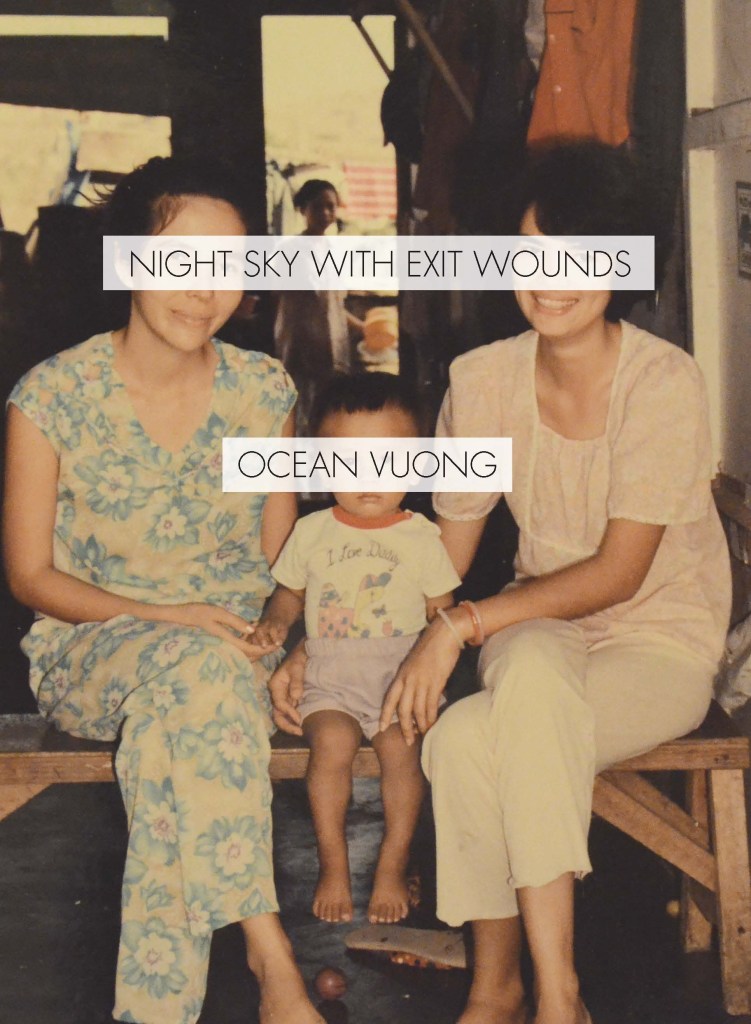
Ocean Vuong, Night Sky With Exit Wounds (2016)
Night Sky With Exit Wounds is a beloved and acclaimed poetry collection that I first read in my first year of college. And I don’t have any memory of it. Almost six years later, I am glad to find that my reading comprehension has improved. It’s such a good book. Despite the fact I studied literature for five years, I am not very confident if the way I interpret poetry is the right way. I know that’s not the point. But the point is, I would like to write about poetry where I am not scrambling to borrow words from other people who have more prolific things to say about all those dead poets, which was all I did in college.
But Ocean Vuong is very much alive. And we also share the same birthday.
Night Sky With Exit Wounds is the book to read if one wants to know how much language can do with very little. It’s a collection of poems about immigration, parents, love and sex. There are lines in this book that are breathtaking, not just as fragments and quotes, but even on the whole its profoundness holds forth.
“…because you don’t have
enough faces to abandon you’ve come
this far to be no one”
(Because It’s Summer)
“Say you’d kill for it. Unbreakable dawn
Mounting in your throat.
My thrashing beneath you
Like a sparrow stunned
with falling.”
(On Earth We’re Briefly Gorgeous)
“Maybe we pray on our knees because god
only listens when we’re this close
To the devil. There is so much I want to tell you.
How my greatest accolade was to walk
across the Brooklyn Bridge
& not think of flight. How we live like water: wetting
a new tongue with no telling
what we’ve been through. They say the sky is blue
but I know it’s black seen through too much distance.”
(Untitled (Blue, Green, and Brown): oil on canvas: Mark Rothko: 1952)
“because you
were never
holy
only beautiful
enough
to be found
with a hook
in your mouth
water shook
like sparks
when they pulled
you out”
(Ode to Masturbation)
“…Listen,
the year is gone. I know
nothing of my country. I write things
down. I build a life & tear it apart
& the sun keeps shining.“
(Daily Bread)
Aase Berg, Dark Matter (2013)
After successfully reading a poetry collection, I approached Aase Berg’s Dark Matter and found it too fragmented for my taste. The introduction says that Aase Berg was inspired by and borrows characters from a lot of pop culture movies. My lack of knowledge in that area might be one of the reasons why I couldn’t parse the poems that well. I would love to revisit it at a later time in my life and see if enjoy it better.
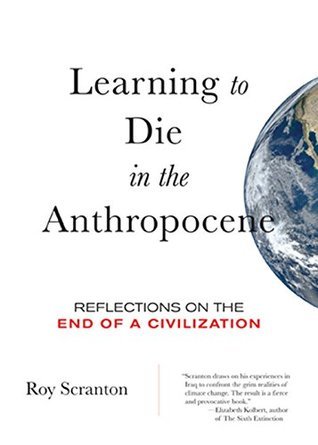
Roy Scranton, Learning to Die in the Anthropocene (2015)
Montaigne said, “To philosophize is to learn how to die”. In Learning to Die in the Anthropocene, as a journalist, Roy Scranton gives an account of the impotence of pacifist climate activism in the past decade and calls for people to philosophise on our demise in this climate crisis.
Georgette Heyer, Devil’s Cub (1932)
Devil’s Cub has the charm of an old rom-com but at times was genuinely offputting. I enjoyed it enough to read through it. But the love interest, the supposed ‘rake’ did not appeal to me at all. There were offhanded hints at domestic abuse and violence. And that’s not something that I want to see treated lightly in the love stories that I read.
October Goals:
Volodine – Eleven Sooty Dreams
Theory – Archaeologies of the Future, Suppose a Sentence
” Each individual member of the subordinate class is encouraged into feeling that their poverty, lack of opportunities, or unemployment, is their fault and their fault alone. Individuals will blame themselves rather than social structures, which in any case they have been induced into believing do not really exist (they are just excuses, called upon by the weak). What Smail calls ‘magical voluntarism’ – the belief that it is within every individual’s power to make themselves whatever they want to be – is the dominant ideology and unofficial religion of contemporary capitalist society, pushed by reality TV ‘experts’ and business gurus as much as by politicians. Magical voluntarism is both an effect and a cause of the currently historically low level of class consciousness. It is the flipside of depression – whose underlying conviction is that we are all uniquely responsible for our own misery and therefore deserve it.”
A few minutes ago, I was reading this old interview with Ali Smith.
With a few clicks on the keyboard, I found myself in the dashboard of this cobwebbed and abandoned blog.
It’s been quite a while since I read any of her works or went down a rabbit hole of nibbling bits and pieces of articles about the great woman on the internet. And it’s been so long since I last blogged. Pardon me, for I seriously couldn’t find meaningfulness behind blogging about books and literature, when I was not reading much.
At this point, I’m sure that I have lost my 3-person readership. But this is more for me to just write all the overwhelming, melancholic and depressing thoughts in my head and less for the sake of others. And I will try and do less pointless meandering because this is also about Ali Smith and I really want to say something beautiful about her.



 Literary Whimsy