What do All’s Well by Mona Awad, Hot Milk by Deborah Levy, Em and the Big Hoom by Jerry Pinto, A Ballad of Remittent Fever by Ashoke Mukhopadhyay (trans. Arunava Sinha) and Small Rain by Garth Greenwell have in common?
I don’t know. That’s what I am trying to find out.
These are the books I chose for my PhD in the semiotics of illness, after a whirlwind of failed ideas, with a steadily growing indifference towards life and literature. It’s strange that I categorize life and literature separately. Since, my life is literature. Avoiding literature would mean avoiding life. Speaking of avoidance, I recently started a new section in my to do list notebook for the tasks that I avoid. My goal is to be kind and non judgemental towards my various failures and procrastinations. The goal is not to be productive, but to be kind enough to get by.
So, I thought I’ll write one of my growing lists of tasks on this blog – that is choosing my last primary source.
“The constant glare of anticipatory grief leaves the labor of care bleached of self-forgiveness.”
dementia campaigner and novelist Nicci Gerrard
my eyes quirk up in joy. I immediately copy/paste her name onto the browser, hoping one of her books would fit the spot as my sixth primary source. It doesn’t matter that I have not read the whole article yet, or that I have not completely read the other selected books that I was supposed to read. I live in a bubble of indifference that only short bursts of fear and shame could break. This is no way to research. This is no real way of living one’s life. But I am getting by.
I wish for the sweet release of unearned results and mediocre solutions. It will eventually come. But Nicci Gerrard is not it.
Rachel Clarke’s Dear Life: A Doctor’s Story of Love and Loss
This sounds ‘relevant’. But not a fiction.
“That it does feature in Dear Life feels all the more significant to me, not simply because Clarke’s description facilitates a personal connection, poignantly reminding me of the strenuous demands of a somewhat taken-for-granted procedure, but also because it exemplifies Clarke’s effort to advance a form of writing that complements one key ambition of the “critical medical humanities” in recent years: to broaden “the sites and scales of ‘the medical’ beyond the primal scene of the clinical encounter.”2 In so doing, Dear Life foregrounds the explicitly affective aspects of attending to patients as an avenue to political activism—pointing to the broader reality that it may be easier to look away from palliative care than to face it.”
Should I change my theory from semiotics to affect. My guide said affect is outdated. But does that really matter?
I imagine them asking me how my research is socially relevant. I want to weep. I should have been stubborn about doing my research on Ali Smith.
Repressed and unaddressed regrets are one of the main reasons for demand avoidance (and no I am not going to cite that statement).
[definition] ‘palliative care’ – Palliative care improves the quality of life of patients and that of their families who are facing challenges associated with life-threatening illness, whether physical, psychological, social or spiritual. The quality of life of caregivers improves as well.
“Released just before the COVID-19 outbreak started to escalate, the book retrieves the particularity of hospice communities from the homogenizing statistics under which they are too often subsumed—cordoned off as the high-mortality “segment” of the general population in the epidemic’s tragic graphs. | And this affecting particularism is one of Clarke’s standout strengths as a writer: it’s crucial to her mission to document the quiddity of illness beyond the threshold of medical rescue, where the familial devastation occasioned by imminent loss is unique for each patient and for each relative.”
[definition] ‘quiddity’ – the distinct, peculiar feature of someone or something
Rachel Clarke, Dear Life: A Doctor’s Story of Love and Loss
Nicci Gerard, What Dementia Tells Us about Love
Christie Watson’s The Language of Kindness: A Nurse’s Story
“What also unites these writers, though, is the ambition to reach beyond the impersonal discourse in which they’ve been trained, honing in its place what they consider to be a much-needed, affectively enriched vocabulary of patient-carer interaction. This impulse syncs with the disciplinary aims of fields that have come to be known as narrative medicine and the health humanities.”
Rita Charon, “Close Reading: The Signature Method of Narrative Medicine,” in The Principles and Practice of Narrative Medicine, by Rita Charon, Sayantani DasGupta, Nellie Hermann, Craig Irvine, Eric R. Marcus, Edgar Rivera Colón, Danielle Spencer, and Maura Spiegel (Oxford University Press, 2017), p. 157
Rita Charon – the signature method of Narrative Medicine – Close Reading
resisting desensitization
“Dear Life sustains one of those conversations with its reader in an attempt to dispel the generalizing vocabulary of horrors that surrounds terminal illness. By returning affective specificity to seemingly hopeless situations of imminent loss, the book also counters what commentators from the health humanities and disabilities studies, such as Rebecca Garden, have called the “tendency to biomedicalise patients,” replacing “narrow mimetic” representations of “preselected” conditions with detailed portraits of “the intersubjective nature of illness.””
[definition] pathography – the study of the life of an individual or the history of a community with regard to the influence of a particular physical or mental condition.
Getting out of bed in the morning was especially hard. I know it’s commonplace for people to say they were so depressed they couldn’t get out of bed in the morning, so much so that excessive sleeping has become one of the official clinical symptoms of depression, but the lived experience has many nuances not captured by colloquial expressions and abstract diagnoses. I would wake up, but I would be unable to make the next move, as though I were literally paralyzed and the only physical difference between being awake and being asleep was that my eyes were open. My state of immobility seemed aimless and unmotivated, not something I could change in any way. I couldn’t even really recognize what possessed me as dread or anxiety.
I would lie in bed thinking but unable to get up, often covered in a layer of sweat that would soak the sheets. It was not the sweat of heat but something else, a kind of animal fear exuding through my pres and leaving a sticky film on my body. During that fellowhsip year, the bed in my furnished rental apartment never became comfortable. I was sleeping on odds and ends of sheets that had been left there; the faded pastel polyester was worn and pilled and felt bad against my skin. (Eventually, I learned to being my own bedding when I move, a simple but effective technique for making my body feel at home.)
I open my blog and immediately close it. I reveal too much here. And there is a severe lack of literary and whimsy to what I write these days. But I believe that one day I would be grateful for recording these thoughts.
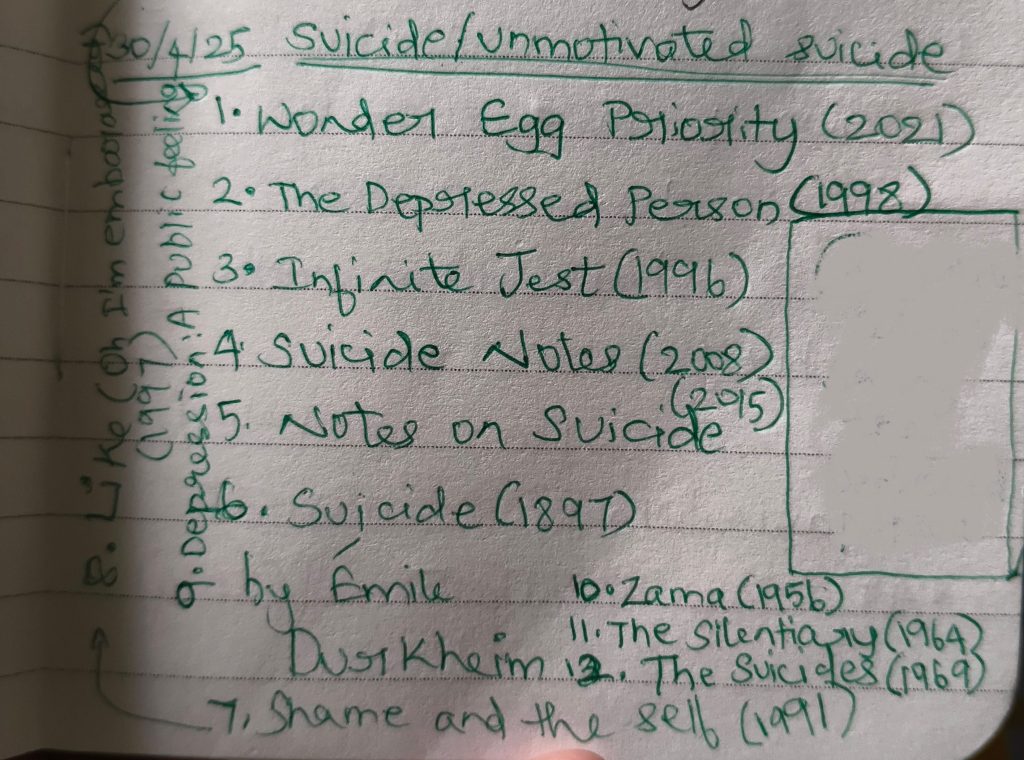
August has been a month of bitter revelations. Someone I am not talking to underwent a surgery. And someone else, in conversation over phone, threatened to kill themself. And it caused a brief moment of ideological cessation in my life. I have been mulling over suicide one way or the other for a very long time. Like hearing an old friend’s name, my ears perk up every time suicide is brought up. I freeze like an imposter when someone says how could they (the suicidee) be so selfish? What about their parents and those they leave behind in grief? I never fully confront it head on. But I really don’t think it’s selfishness.
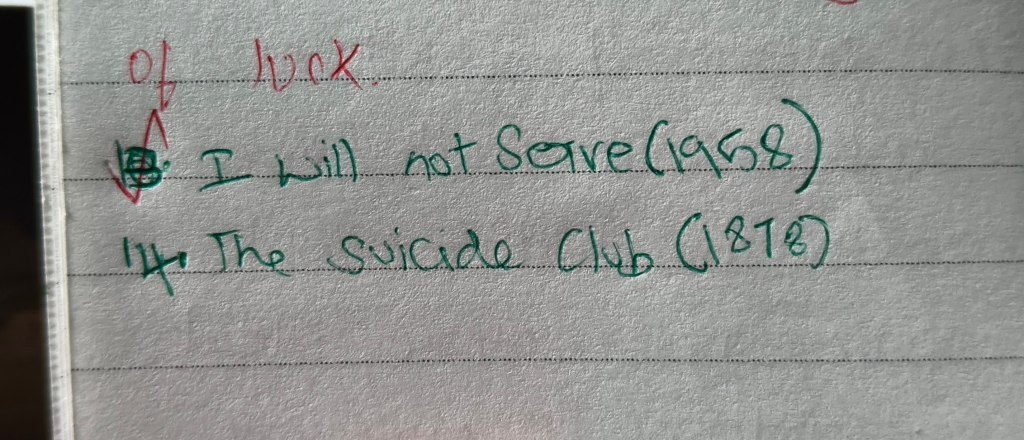
Killing oneself is such an ugly thing. I wouldn’t do it. But I also cannot forgo the fact I’ve used suicidal ideation as a coping mechanism my whole life – an emotional release in times of distress. Not unlike masturbation, I have fantasized death in many ways. Images of violence and catharsis fill my mind when things go out of control. The idea that there’s an option that life with all the things that hurt could immediately stop is too tantalizing sometimes. Talking about it has only lead to miscommunication and exhaustion. But repressing it is not going to end well for me. In the past year I’ve been committed to mapping notions of suicide, in literature and in the world around me – trying to form my own philosophy on suicide, intellectualize it – that I was surprised at feeling unpleasant when suicide was brought up so brashly, outside the framework of literature. I hated being blackmailed and even more I hated what I thought to be a higher intellectual indulgence shown in context of the real world. And I kept saying the same old script people say to a suicidal person. All the nuance, I thought I had, didn’t come through.
Do I think that my suicidal thoughts are different (and better) than others? That’s not good. It’s narcissism, clearly. But I am so desperate to become wise and put things in perspective. I know it’s going to take time for me to achieve that. But why can’t it happen now? I want to feel good now, immediately if possible. It’s not a very wise thing to say. But the lesser-me persists.
“They dress themselves up. They act their parts. One leads; the other follows. One is romantic, the other realist. One is advanced, the other out of date. There is no harm in it, so long as you take it as a joke, but once you believe in it, once you begin to take yourself seriously as a leader or as a follower, as a modern or as a conservative, then you become a self–conscious, biting, and scratching little animal whose work is not of the slightest value or importance to anybody. Think of yourself rather as something much humbler and less spectacular, but to my mind, far more interesting—a poet in whom live all the poets of the past, from whom all poets in time to come will spring. You have a touch of Chaucer in you, and something of Shakespeare; Dryden, Pope, Tennyson—to mention only the respectable among your ancestors—stir in your blood and sometimes move your pen a little to the right or to the left. In short you are an immensely ancient, complex, and continuous character, for which reason please treat yourself with respect and think twice before you dress up as Guy Fawkes and spring out upon timid old ladies at street corners, threatening death and demanding twopence–halfpenny. —from “A Letter to a Young Poet,” 1932″
Different versions of text have inhibited this space under this picture of the Falling Waters. Shifting texts of shifting degrees of truth. What was once a suicide note, later a moment of momentous clarity, all absconding into pointless disingenuity. I have been swapping words like swapping moods.
What was I thinking? And why do I revise myself so much in this empty room? For whose sake? And for what cause?
I have been a terrible person. I have not lived by my principle. And I have lost my capacity for truth. I have let myself go.
The longer it goes, the longer the meaning stretches itself into meaninglessness. Nothing I say will make sense. So I will say nothing. But I will never go back. I promised myself that. And I cannot go forward. I am comforted and coddled by this place in-between. So let me lie here for a while and write vague stuff.
“Think of Greta Gerwig’s Barbie movie, whose big set piece is not a musical number or fantasy sequence but a speech by America Ferrara’s character about all the contradictory demands that make it “impossible to be a woman.” The lines are plausible in the mouth of the character, but there is an inescapable sense that they are above all channeling the voice of the film, providing a gloss or commentary on itself, modeling how we are to receive it. In other words, the pivotal scene in Barbie is a distilled and embodied version of a think piece about Barbie.”
“More than the real slop, which can sometimes seem like random firings of hedonic sensation detached from meaning, and more than the stuff that announces itself as Art, with its aspirations to autonomy, mid media give us corporate art’s frankest account of what it is up to in our world. To want any more from it would probably be a mistake, but to ignore what it is so blatantly telling us would be an abdication of our responsibility as critics.”
“What happens when literary scholars venture away from the work and fields we’re trained in and rove the land of pignoli cookies, oranges, diamonds, and champagne? And what happens when we treat that escape seriously? Not only then do we revel in the breaks necessary to make our work better, but we also surprise ourselves by learning how to mine a text intimately, to look for how it’s made, how it works, and why it works.”
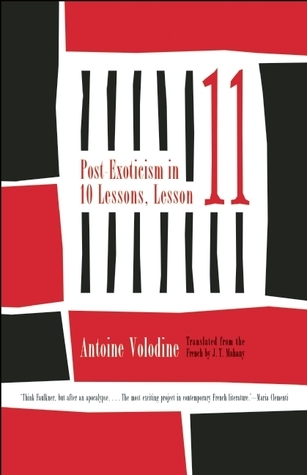
Antoine Volodine, Post-Exoticism in Ten Lessons, Lesson Eleven (1998)
In Post-Exoticism in Ten Lessons, Lesson Eleven, Volodine, with his varied pseudonyms and personas lays out the framework of post-exoticism. The book’s zany makes itself evident right from the title. This is an attempt at telling what post-exoticism means. It’s form, style, tradition and history. And there is a post-revolutionary rage to it all. Categorically, it’s prison literature. But it’s also a prison literature about prison literature.
“We repeat it nonstop. It is part of post-exoticism.”
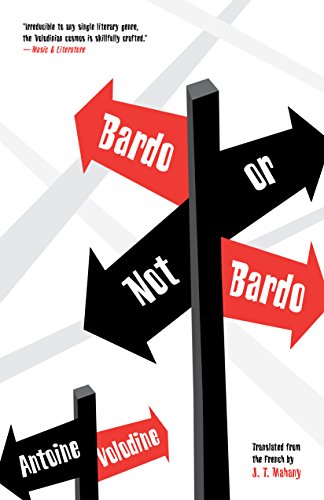
Antoine Volodine, Bardo or Not Bardo (2016)
Version 1.0.0
Bardo or Not Bardo was a fever dream, more so than Post-Exoticism. It’s an exploration of death and how religion, at its core, has always been about bringing light to what happens after death. It reminded me a lot about the way the Mike Flanagan show Midnight Mass (2021) dealt with death. Not because they were similar. But because both the works approached a specific aspect of death from two completely different perspectives.
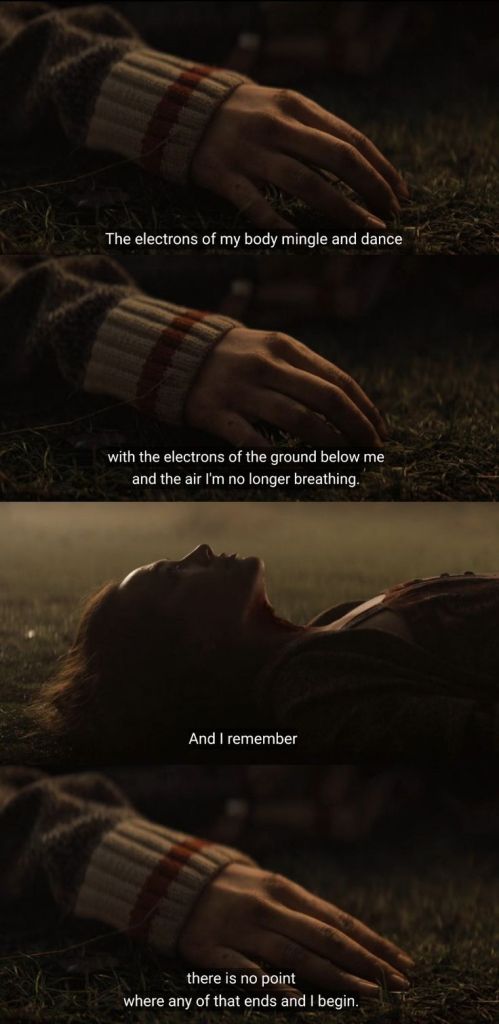
The premise in both works is that death is an opportunity for the body to perish and the soul to become one with the nothingness of the cosmos. While Midnight Mass embraces this oneness, Bardo stands against it. It argues that losing one’s individuality, life, dreams and friendships is too much of a cost for enlightenment. In that regard, I agree with Bardo.
The nihilism of Midnight Mass makes me uncomfortable. Because, if we are preaching that at the moment of death, the life we lived doesn’t matter. All the memories, friendships, breakups, love and pain, were just pictures collected along the way, what was the point of living? And what was the point of trying? Because there are people in pain, those battling suicidal thoughts . And this ideology where death is the point of life can be harmful to the vulnerable.
And that’s the point Bardo or Not Bardo makes.
These are two quotes from both works about the moment of death.
“Renounce, be one with them, dissolve into them…”
“No,” says Schmollowski, “That’s where we…’Noble son, renounce, cease to be a person! ‘Join the collectivity of the nothing!’ ‘Noble son, cease to be conscious of yourself!’ No, there’s no way I’d adopt the Red Bonnets Anonymous philosophy. No way I’m accompanying them on this territory. No, really…it’s too suicidal. I won’t walk…”
Gong.
“Not for me!” Schmollowski shouts in the direction of the loudspeaker. “Too suicidal!”
There were a lot of delightful monologues and imagery, along with confusing names, and plotlines. I enjoyed it a lot. But then, I ask myself, Wait what happened to that character? And I have no idea. Very reminiscent of my experience reading One Hundred Years and Pedro Paramo. Hopefully, I catch the things that I missed in rereadings.
Below is a quote that was very meaningful to me at the time when I read it.
“I’m in a funk myself. Once you’re aware you’re trapped in life without any way to get out… And then, when you think about those who did get out … When you imagine what happens to them after… At this very moment, for example…”
Uh, so much is said in this vagueness. I love Volodine!
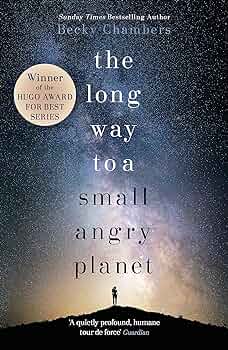
Becky Chambers, The Long Way to a Small, Angry Planet(2014)
I was on a mission to read all of Volodine’s books before this year ended. But after Bardo, I had to take a break and read something comforting and traditional in its form. And there couldn’t have been a better book than, ‘The Long Way to a Small Angry Planet’.
Wayfarer is a spaceship that is home to a crew of humans and aliens, a found family of sentient friends who would warm anyone’s heart.
I really felt for the characters and their friendships, to the point when a character was nice to another, it legit made me cry. Recently, I have been going through some stuff in life. I don’t know if I am going to come out on the other side of this with my dignity intact. But reading about these people, most of them space aliens, trying to do their best with what they have, trying to be honest people made me so ridiculously happy.
“Dr Chef knew exactly where all of his feelings were, every joy, every ache. He didn’t need to visit them all at once to know they were there. Humans’ preoccupation with ‘being happy’ was something he had never been able to figure out. No sapient could sustain happiness all of the time, just as no one could live permanently within anger, or boredom, or grief. Grief. Yes, that was the feeling that Rosemary needed him to find today. He did not run from his grief, nor did he deny its existence. He could study his grief from a distance, like a scientist observing animals. He embraced it, accepted it, acknowledged that it would never go away. It was as much a part of him as any pleasant feeling. Perhaps even more so.”
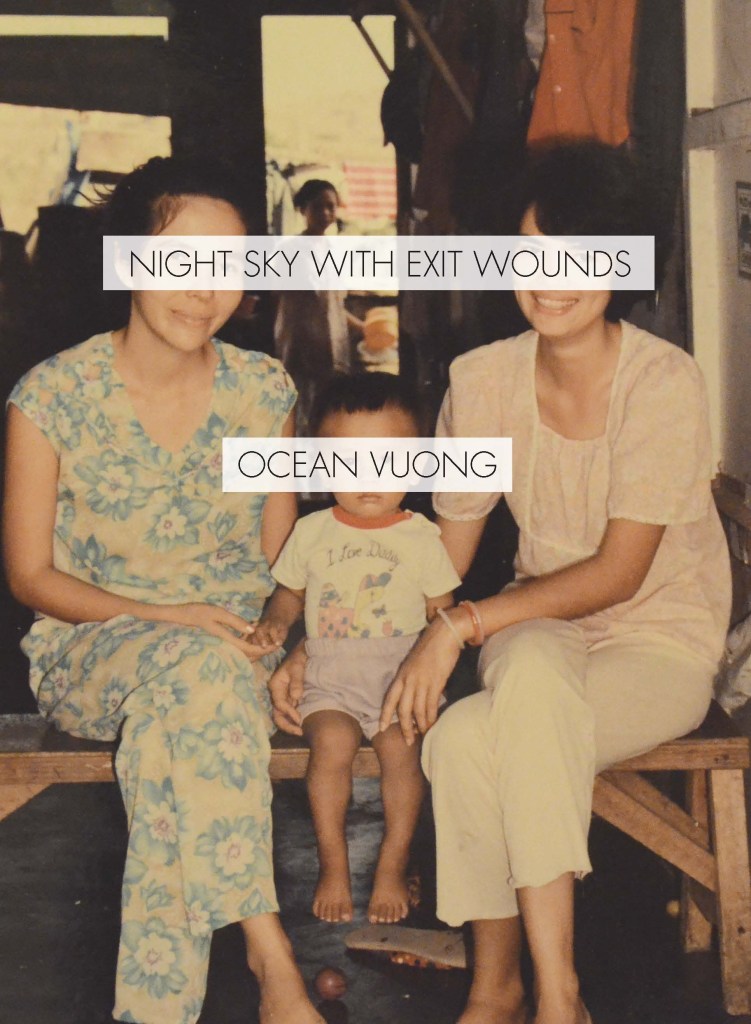
Ocean Vuong, Night Sky With Exit Wounds (2016)
Night Sky With Exit Wounds is a beloved and acclaimed poetry collection that I first read in my first year of college. And I don’t have any memory of it. Almost six years later, I am glad to find that my reading comprehension has improved. It’s such a good book. Despite the fact I studied literature for five years, I am not very confident if the way I interpret poetry is the right way. I know that’s not the point. But the point is, I would like to write about poetry where I am not scrambling to borrow words from other people who have more prolific things to say about all those dead poets, which was all I did in college.
But Ocean Vuong is very much alive. And we also share the same birthday.
Night Sky With Exit Wounds is the book to read if one wants to know how much language can do with very little. It’s a collection of poems about immigration, parents, love and sex. There are lines in this book that are breathtaking, not just as fragments and quotes, but even on the whole its profoundness holds forth.
“…because you don’t have
enough faces to abandon you’ve come
this far to be no one”
(Because It’s Summer)
“Say you’d kill for it. Unbreakable dawn
Mounting in your throat.
My thrashing beneath you
Like a sparrow stunned
with falling.”
(On Earth We’re Briefly Gorgeous)
“Maybe we pray on our knees because god
only listens when we’re this close
To the devil. There is so much I want to tell you.
How my greatest accolade was to walk
across the Brooklyn Bridge
& not think of flight. How we live like water: wetting
a new tongue with no telling
what we’ve been through. They say the sky is blue
but I know it’s black seen through too much distance.”
(Untitled (Blue, Green, and Brown): oil on canvas: Mark Rothko: 1952)
“because you
were never
holy
only beautiful
enough
to be found
with a hook
in your mouth
water shook
like sparks
when they pulled
you out”
(Ode to Masturbation)
“…Listen,
the year is gone. I know
nothing of my country. I write things
down. I build a life & tear it apart
& the sun keeps shining.“
(Daily Bread)
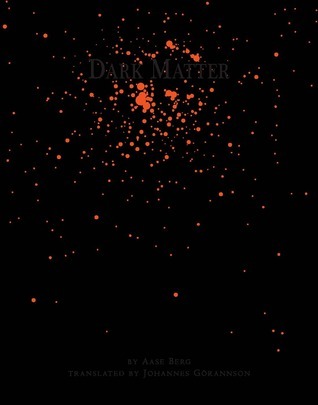
Aase Berg, Dark Matter (2013)
After successfully reading a poetry collection, I approached Aase Berg’s Dark Matter and found it too fragmented for my taste. The introduction says that Aase Berg was inspired by and borrows characters from a lot of pop culture movies. My lack of knowledge in that area might be one of the reasons why I couldn’t parse the poems that well. I would love to revisit it at a later time in my life and see if enjoy it better.
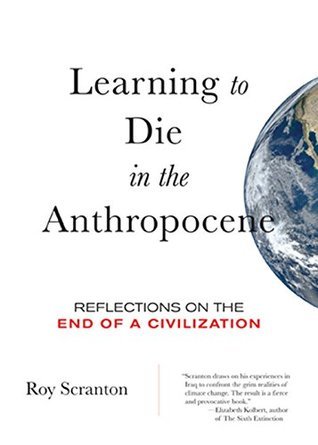
Roy Scranton, Learning to Die in the Anthropocene (2015)
Montaigne said, “To philosophize is to learn how to die”. In Learning to Die in the Anthropocene, as a journalist, Roy Scranton gives an account of the impotence of pacifist climate activism in the past decade and calls for people to philosophise on our demise in this climate crisis.
Georgette Heyer, Devil’s Cub (1932)
Devil’s Cub has the charm of an old rom-com but at times was genuinely offputting. I enjoyed it enough to read through it. But the love interest, the supposed ‘rake’ did not appeal to me at all. There were offhanded hints at domestic abuse and violence. And that’s not something that I want to see treated lightly in the love stories that I read.
October Goals:
Volodine – Eleven Sooty Dreams
Theory – Archaeologies of the Future, Suppose a Sentence
” This is how Eve Sedgwick teaches us to read—not from a paranoid position, but from a reparative position that tries to find “the many ways selves and communities succeed in extracting sustenance from the objects of a culture—even of a culture whose avowed desire has often been not to sustain them.”
” All too often criticism points out dehumanizing aspects of the world only to further depersonalize our experience.”
“Shantideva approaches this question through a position of radical empathy that dissolves the divide between the self and the other. We would do well to try and do the same. Reading deeply is a good place to start.”
“The story of the struggle to find one’s way into philosophy, the struggle to find one’s philosophical voice, is a struggle to find a language ― a point I took rather literally. But the story of that struggle is also one’s intellectual autobiography.”
“Marxism is, in Jameson’s view, the only critical approach capable of making sense of human experience as a historical phenomenon.”
“Dialectical thinking, Jameson has said, “requires you to say everything simultaneously, whether you think you can or not,” and there is a strong sense of that in his prose. “We will return to this later,” “meanwhile,” “as we have seen,” are common refrains. Remarking on this element of Jameson’s style in his review of Valences of the Dialectic (2009), Benjamin Kunkel observed that it is “as if everything was present in his mind at once, and it was only the unfortunately sequential nature of language that forced him to spell out sentence by sentence and essay by essay an apprehension of the contemporary world that was simultaneous and total.””
“One trait of postmodernism unmentioned by Jameson was the special difficulty critics and thinkers of recent generations have experienced in conveying their thoughts except through the medium of someone else’s; intellectuals today tend to offer their commentary on the world by way of comments on another’s commentary.”
“And you could say that American higher education itself suffered a dialectical reversal somewhere around 1980 – to date, the high-water mark of class mobility in the US – as the universities went from being among the main vehicles of egalitarianism to being the primary means of reproducing class privilege.”




 Literary Whimsy